Citations Are Not Enough: Grounding AI-Generated Instructional Materials in Real Sources

1Arizona State University

AI-Native Academia Workshop at NeurIPS 2026 (Poster)

This work extends Instructional Agents (EACL 2026), a multi-agent framework that generates a full course: syllabus, slides, lecture scripts and assessments. It adds an opt-in textbook mode. With --use-textbook PATH, every slide is written from passages of the instructor's textbook, and every slide sentence is checked against that book. Without the flag, Instructional Agents runs as before.
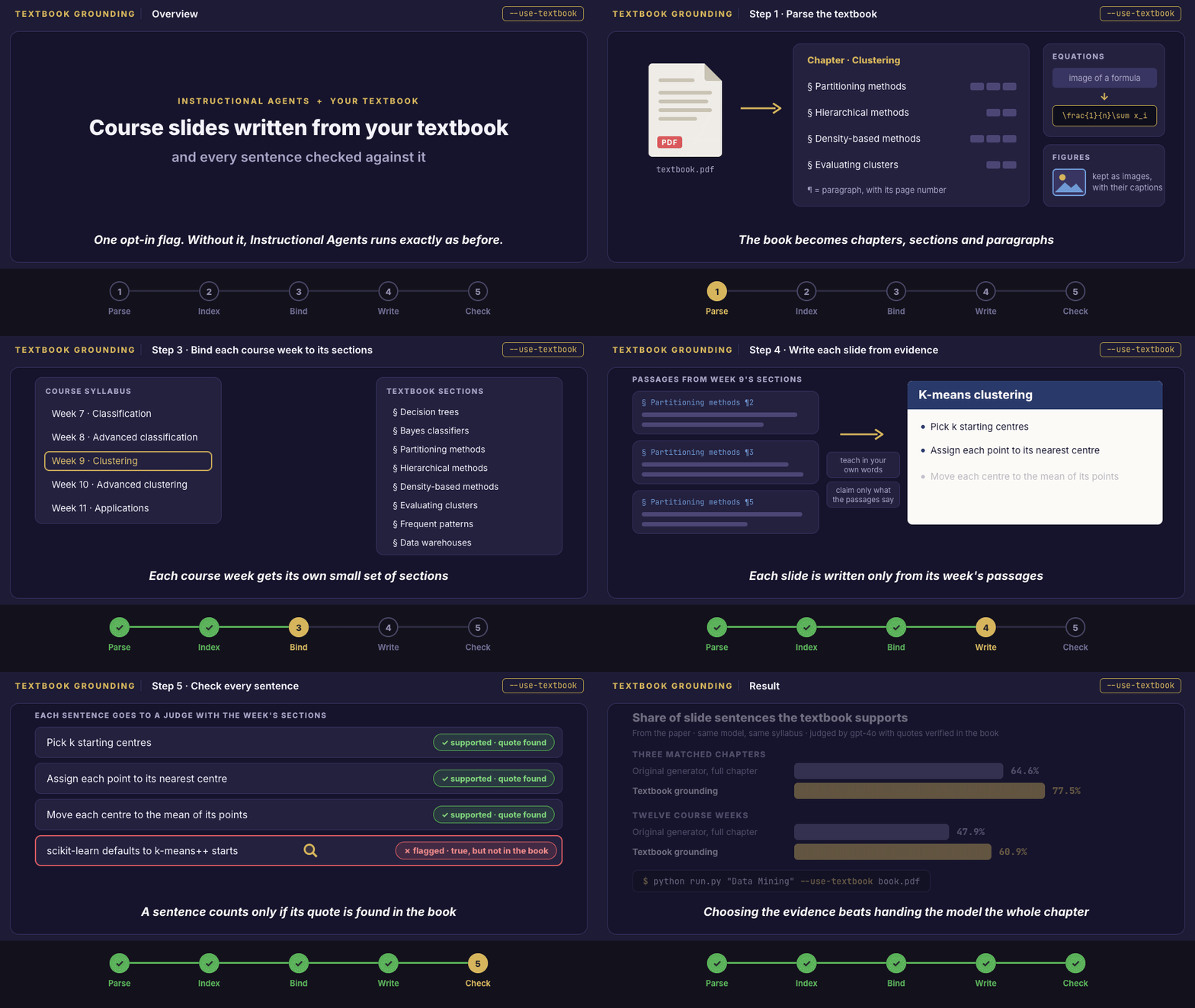
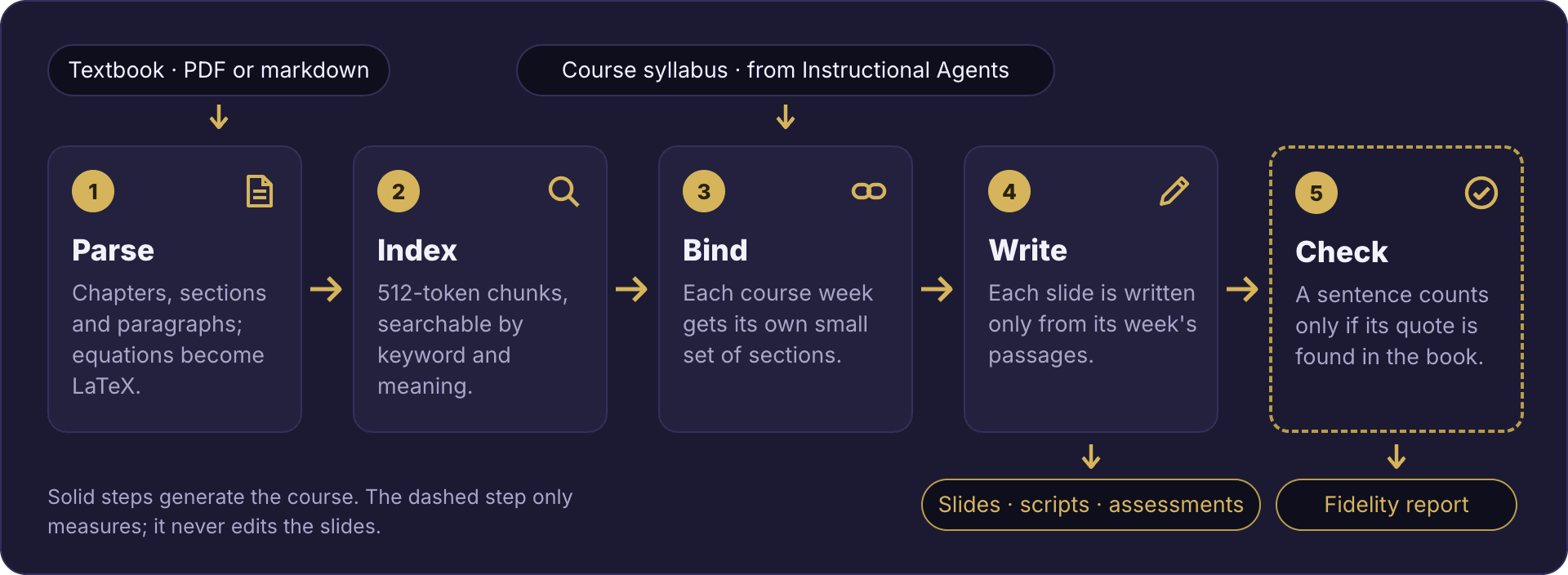
Animated walkthrough: a textbook is parsed and indexed, each course week is bound to its own textbook sections, each slide is written from those passages, and every slide sentence is checked against the book

Why ground course materials in a textbook?

Instructional Agents writes a course from the language model's own knowledge. A course taught from a textbook should instead say what that book says, and the instructor should be able to check it. Placing the whole chapter in the prompt does not solve this: much of what the model writes is still absent from the book. Controlling which passages the model sees works better.

How does it work?

Five steps: parse the textbook, index it, bind each course week to its own sections, write each slide only from its week's passages, and check every sentence. The check writes a fidelity report and never edits the slides.
  1. Parse. A PDF or markdown textbook becomes a chapter, section and paragraph structure. Figures are kept as images, and images of equations are converted to LaTeX.
  2. Index. Paragraphs are split into chunks of about 512 tokens and indexed for keyword search (BM25) and semantic search (text-embedding-3-large). Reciprocal rank fusion combines the two rankings.
  3. Bind. Before any slide is written, each course week is bound to a small set of textbook sections, chosen by ranking sections across several queries expanded from the week's topic. A week that matches the book weakly is still bound to its best sections, and the low confidence is recorded.
  4. Write. Each slide is written only from passages retrieved from its week's sections. The writer teaches in its own words, keeps worked examples and notation, and adds nothing the passages do not support. Textbook figures, captions and tables are carried onto the slides.
  5. Check. Every slide sentence is judged against the full text of the week's sections. A sentence counts as supported only when the judge quotes supporting text that is then found word for word in the book. The check writes a per-chapter fidelity report and never edits the slides.

How much of the slides does the textbook support?

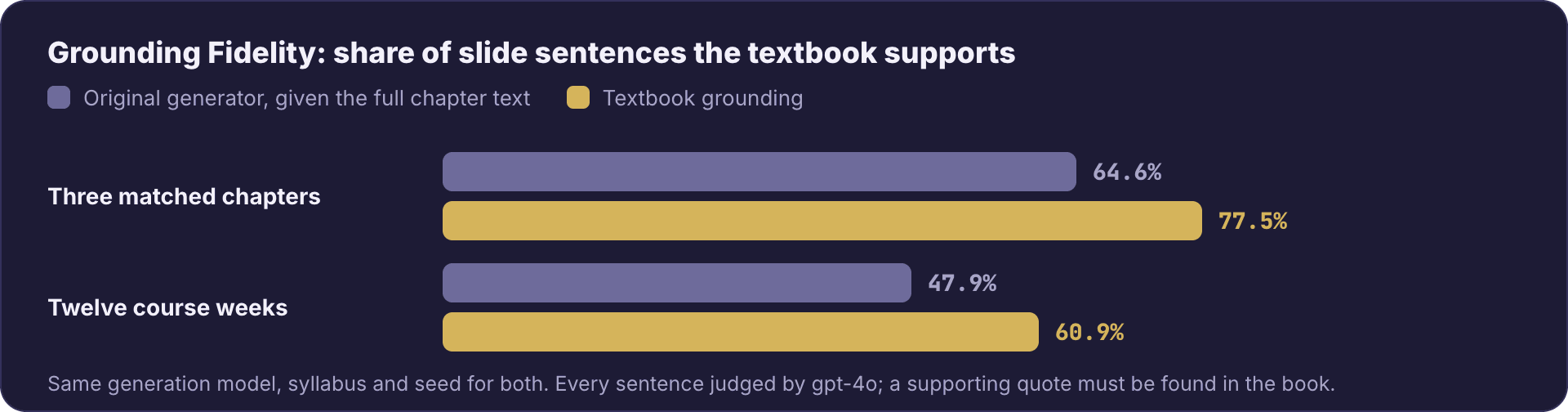
We measure Grounding Fidelity: the share of slide sentences that the textbook supports. On three matched chapters, textbook grounding reaches 77.5%, compared with 64.6% for the original generator given the full chapter text. Across twelve course weeks, it reaches 60.9% versus 47.9%.

Grounding Fidelity, the share of slide sentences the textbook supports. Three matched chapters: 64.6% for the original generator given the full chapter text, 77.5% with textbook grounding. Twelve course weeks: 47.9% versus 60.9%.

Which components matter?

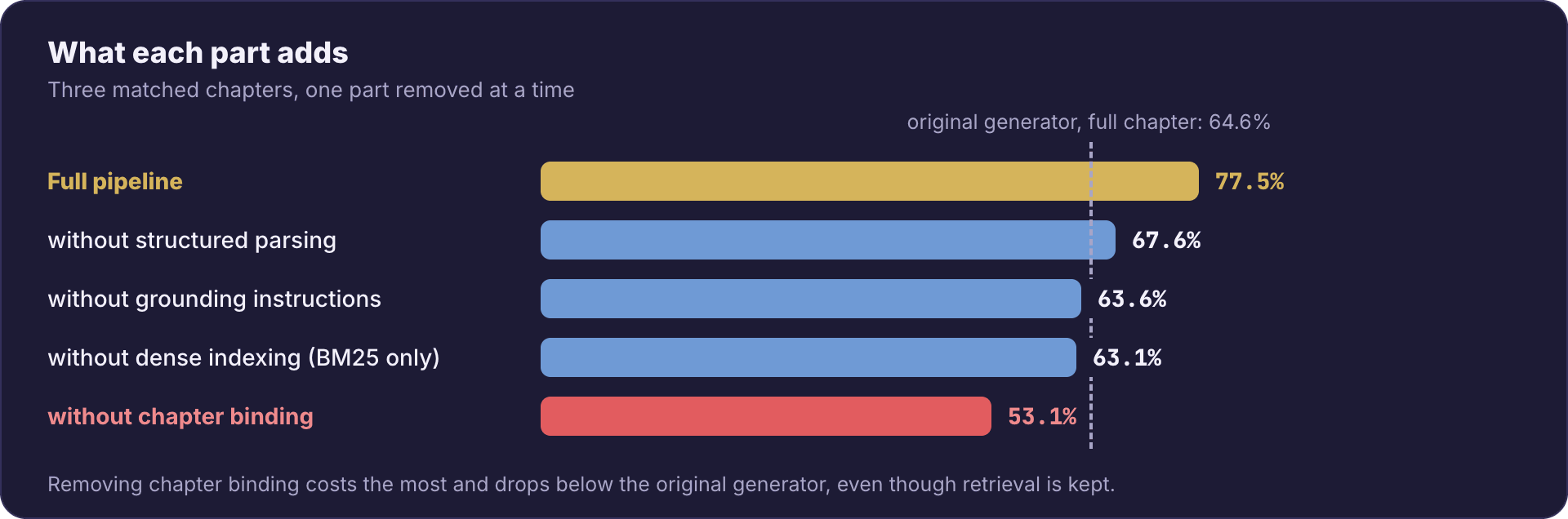
Removing one component at a time on the three matched chapters lowers fidelity in every case. Chapter binding matters most: without it, fidelity falls from 77.5% to 53.1%, below the 64.6% of the original generator with the full chapter. Removing structured parsing, grounding instructions or dense indexing gives 67.6%, 63.6% and 63.1%.

Removing one part at a time on three matched chapters: full pipeline 77.5%, without structured parsing 67.6%, without grounding instructions 63.6%, without dense indexing 63.1%, without chapter binding 53.1%. The original generator with the full chapter scores 64.6%.

Week by week

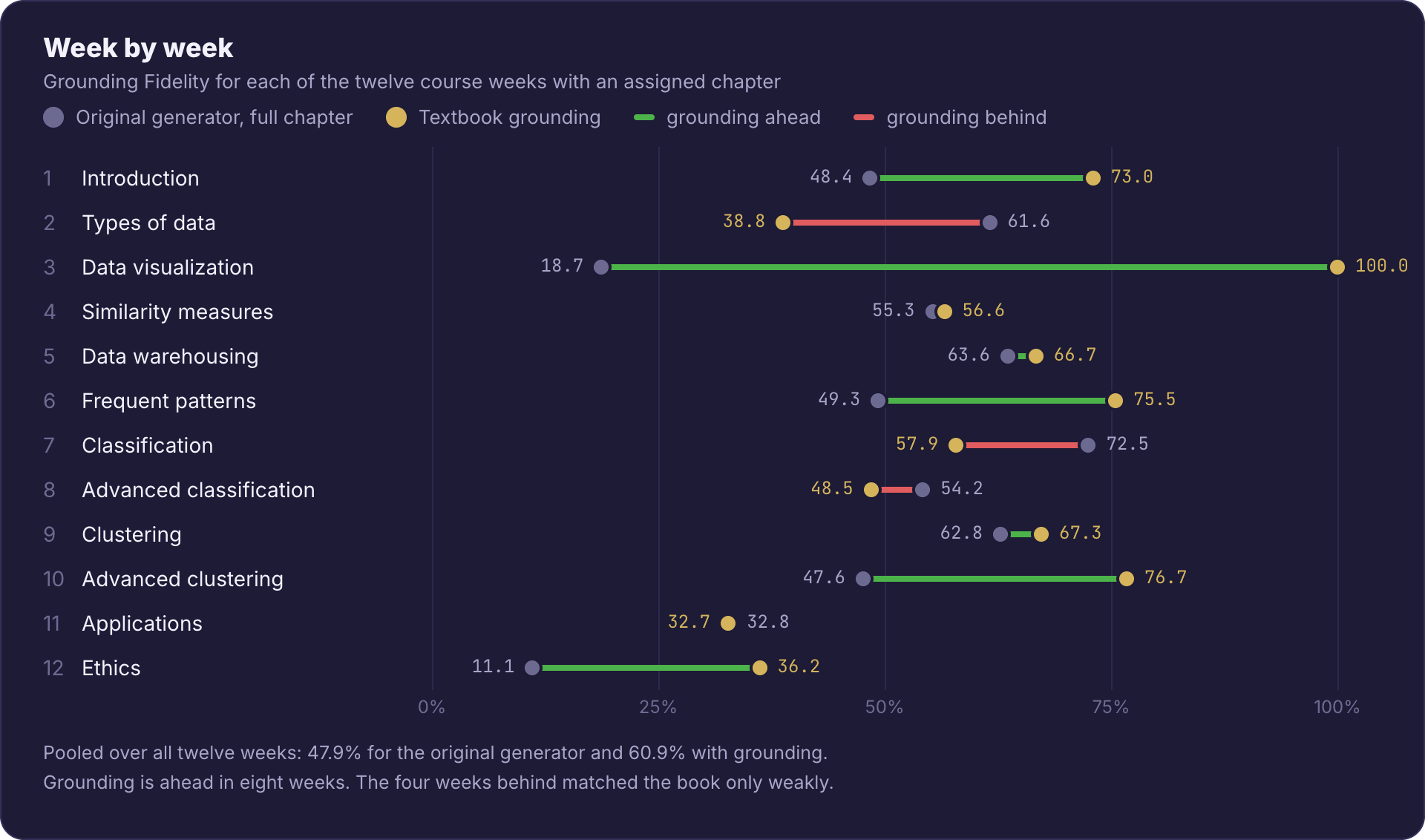
Grounding is ahead of the original generator in eight of the twelve weeks. The automated judge agrees with majority human labels on 90.8% of decidable claims.

Grounding Fidelity for each of the twelve course weeks, original generator versus textbook grounding. Grounding is ahead in eight weeks.

Quick start

git clone -b feature/textbook-grounding https://github.com/DaRL-GenAI/instructional_agents.git
cd instructional_agents
pip install -e ".[grounding]"
export OPENAI_API_KEY=your_api_key_here

# Generate a course from your textbook
python run.py "Data Mining" --catalog default_catalog --exp dm_grounded \
    --use-textbook path/to/textbook.pdf

# Score it, including the course-level Grounding Fidelity %
python evaluate.py --exp dm_grounded --rigorous

Bring your own PDF or markdown textbook; none ships with the repository. Each chapter's output includes a Beamer deck with textbook figures, a speaker script, an assessment, and content_verification.json, which lists every sentence as supported (with its quote) or flagged. See the README for all options.

The results in the paper were produced with commit 3b9dd16 of this branch.

Known limitations

  • Broad survey weeks, such as an introduction or a review, match the book weakly and usually score lower.
  • The judge is a language model. Its quotes are checked mechanically, but individual verdicts can still be wrong.

BibTeX

@inproceedings{bishnoi2026citations,
  title={Citations Are Not Enough: Grounding {AI}-Generated Instructional Materials in Real Sources},
  author={Shrey Bishnoi and Wanpeng Xu and Tiejin Chen and Hua Wei},
  booktitle={NeurIPS 2026 Workshop on AI-Native Academia: Authorship, Peer Review, and Conference Governance under AI},
  year={2026},
  url={https://openreview.net/forum?id=9gUnAbgrs1}
}

This work builds on Instructional Agents:

@misc{yao2025instructionalagentsllmagents,
  title={Instructional Agents: Reducing Teaching Faculty Workload through Multi-Agent Instructional Design},
  author={Yao, Huaiyuan and Xu, Wanpeng and Turnau, Justin and Kellam, Nadia and Wei, Hua},
  year={2025},
  eprint={2508.19611},
  archivePrefix={arXiv},
  primaryClass={cs.AI},
  url={https://arxiv.org/abs/2508.19611},
}